【论文信息】
Wu Q Q,Chen W*(通讯作者).How can carbon finance drive renewable energy resilience? Insights from spatial spillovers[J]. Energy (SCI JCR Q1,中科院SCI一区Top期刊).2026, 346: 140224.https://doi.org/10.1016/j.energy.2026.140224.
【作者信息】
第一作者:吴奇其,陈伟教授指导的2024级博士研究生,研究方向:能源技术创新;
通讯作者:陈 伟,博士、教授、博士生导师,研究方向:供应链管理、技术创新管理。
【基金支持】
国家文化英才培养工程专项资助项目(2021QNYC098);国家社会科学基金项目(23BGL063)。
【论文摘要】
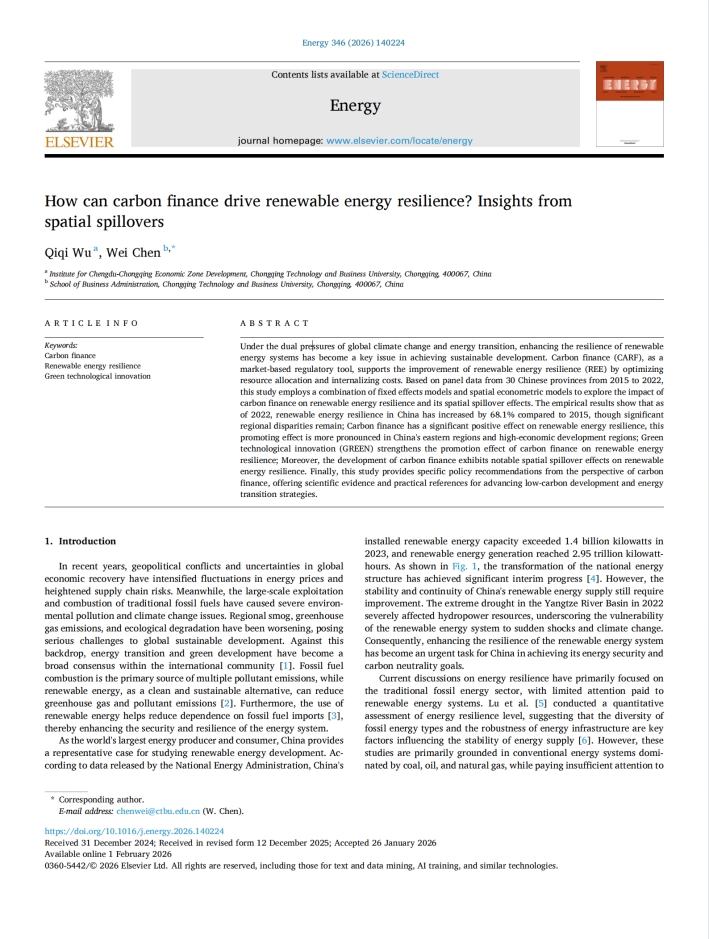
Under the dual pressures of global climate change and energy transition, enhancing the resilience of renewable energy systems has become a key issue in achieving sustainable development. Carbon finance (CARF), as a market-based regulatory tool, supports the improvement of renewable energy resilience (REE) by optimizing resource allocation and internalizing costs. Based on panel data from 30 Chinese provinces from 2015 to 2022, this study employs a combination of fixed effects models and spatial econometric models to explore the impact of carbon finance on renewable energy resilience and its spatial spillover effects. The empirical results show that as of 2022, renewable energy resilience in China has increased by 68.1% compared to 2015, though significant regional disparities remain; Carbon finance has a significant positive effect on renewable energy resilience, this promoting effect is more pronounced in China's eastern regions and high-economic development regions; Green technological innovation (GREEN) strengthens the promotion effect of carbon finance on renewable energy resilience; Moreover, the development of carbon finance exhibits notable spatial spillover effects on renewable energy resilience. Finally, this study provides specific policy recommendations from the perspective of carbon finance, offering scientific evidence and practical references for advancing low-carbon development and energy transition strategies.